
Feng Shui My Home: Looking at the Spaces We Live In With Fresh Eyes


I've become curious about feng shui.
It started, as these things often do with me, with one thought leading to another. I was looking around my own home and thinking about how certain spaces feel, then I watched a video about rearranging the things we already own. Move an object we've stopped noticing.
Group things in odd numbers such as three, five or seven. Vary their heights. Change the familiar enough, that we become aware of our surroundings again.
That idea stayed with me.
Then feng shui wandered into the picture, and I started wondering how much the two might have in common. Feng shui has a much deeper history and philosophy than moving a few ornaments around, of course, and I'm certainly no expert in it. I'm learning as I go.
So, I thought it might be interesting to start at the front door, work our way through the house and see what it actually means to feng shui your home — especially when you're working with an ordinary home, the things you already own and absolutely no desire to start knocking down walls.
No major renovations required.
Feng Shui Is More Than Moving the Furniture
One of the first things I discovered is that feng shui isn't really an interior decorating system, although that's often how we encounter it today.
The words feng shui mean “wind” and “water”, and the traditional Chinese practice is concerned with the relationship between people and their environment. Among its important ideas are qi — often described as vital energy — yin and yang, orientation, the landscape and the five elements of wood, fire, earth, metal and water.
There are different schools and interpretations too, which was reassuring because I quickly realised there isn't always one universally agreed answer to the question, Where should I put the couch?
What I do like is the underlying idea of paying attention to the relationship we have with the places in which we live.
That seems a very good place to start.
Let's Begin at the Front Door
The entrance caught my attention first because my own front door opens into a foyer with a brick wall directly ahead. I've lived with it for about a year, but recently I started wondering about the way it makes the entrance feel. You walk in and, visually at least, you meet a full stop.
That sent me looking into what feng shui has to say about entrances.
From what I've been reading, entrances are significant because they affect how qi approaches and moves through a home. Traditional feng shui is concerned with whether qi gathers, moves or disperses, although the original practice was considerably more complex than the modern advice we often see about decorating a foyer.
Still, it made me look at my entrance differently.
And that's really what I want to explore here. What happens when the entrance to a home feels blocked, dark, cluttered or cramped? If we can't — or don't want to — change the architecture, are there smaller ways to make the space feel as though it flows?
Maybe it's a plant, different lighting, artwork or removing something altogether. It might mean drawing the eye toward the direction the house opens rather than toward whatever appears to stop it.
I'm particularly interested in the feng shui idea of prosperity here. I don't think prosperity needs to mean a sudden pile of money appearing because we've moved a pot plant. It can encompass opportunity, abundance, wellbeing and growth.
And, I'm not suggesting that a brick wall is secretly plotting against anyone's prosperity. Mine may be entirely innocent.
But if changing an entrance makes it feel lighter, more welcoming and more open, I'm willing to experiment.
Walk Through Your Home as Though You've Never Seen It
This may be my favourite idea so far, and it isn't exclusively feng shui.
We become accustomed to our homes.
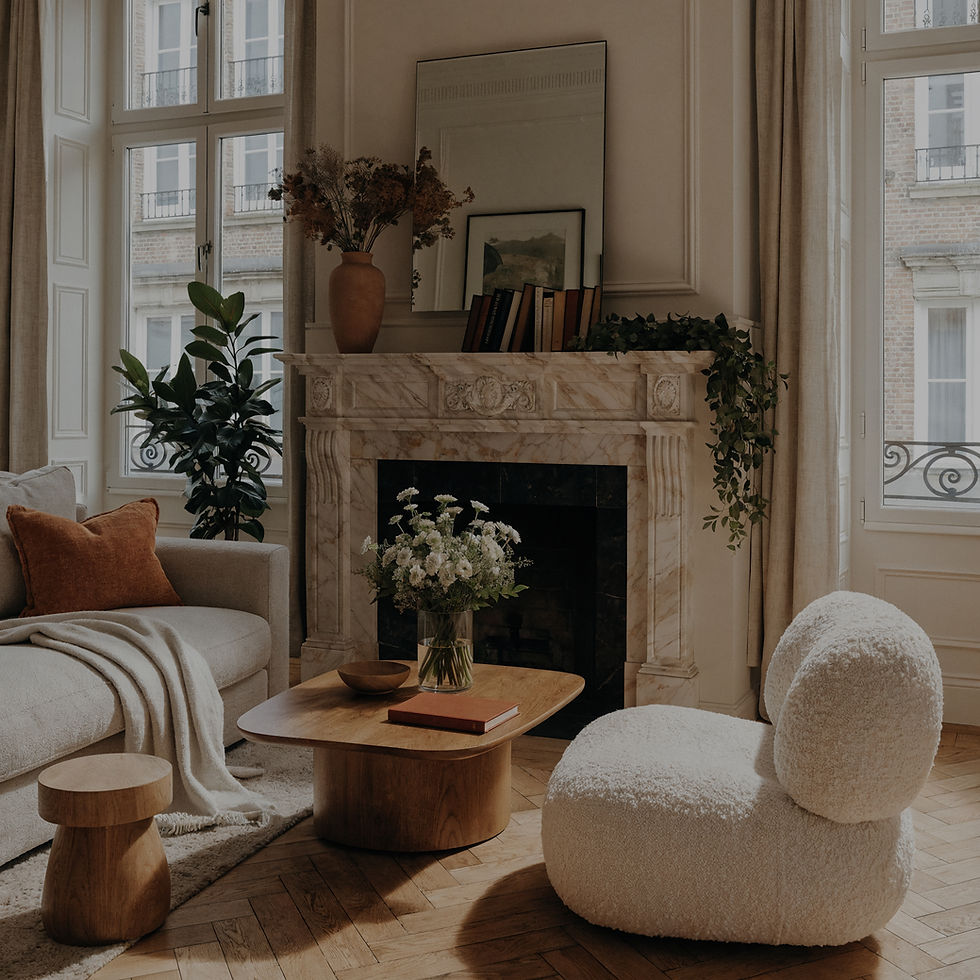
The vase has been there for six years. That chair has always sat in that corner. The photographs have occupied the same shelf for so long that we barely look at them anymore.
We still see these things, of course, but we don't really notice them.
Try walking outside and coming back through the door while pretending you're visiting for the first time. What catches your eye? Where does your gaze stop? Is there somewhere your body has to manoeuvre around furniture? Is there a dark corner you've become accustomed to? Is the first thing you see something you actually enjoy seeing?
That little exercise costs nothing, yet it can reveal quite a lot.
Move Something and See What Happens
While looking into all this, I came across another idea I loved: periodically rearranging the things in our homes.
Move the lamp. Swap two pieces of artwork. Put the vase somewhere else. Take three objects off a shelf and return only two. Bring something out of a cupboard that you love but haven't seen for years.
There are also interior styling principles that use odd-numbered groupings — particularly three, five and seven — and variations in height to make arrangements more visually interesting.
I wouldn't call that ancient feng shui. It belongs more comfortably in the world of interior styling, but I think the ideas can live happily beside one another.
Try three objects of different heights rather than three objects lined up evenly. Leave some empty space around them. Move something familiar somewhere unfamiliar.
Then see whether you notice it again.
Maybe refreshing the energy of a room sometimes begins with refreshing our attention.
The Living and Family Rooms: Where Life Actually Happens
This is where I think practicality needs to win over perfection.
Living rooms are lived in. There are televisions, toys, books, cups of tea, charging cables, people wandering through and someone inevitably putting something down where it doesn't belong.
A home shouldn't have to look like nobody lives there to feel peaceful.
What interests me about feng shui here is flow. Can people move comfortably through the room? Does the furniture encourage conversation? Is there somewhere comfortable to sit without feeling as though you're perched in the middle of a walkway?
Furniture placement is one of the areas where feng shui often discusses a “commanding” position — broadly, being able to see the entrance to a space without sitting or sleeping directly in line with it.
Whether we follow that precisely or not, I understand the appeal. There is something naturally comfortable about sitting somewhere that allows us to see the room and the people entering it.
So rather than immediately buying new furniture, I'm going to look at positioning first.
Could the room work better simply by moving what is already there?
The Kitchen and Dining Area
The kitchen is another interesting space because it represents nourishment in both the literal and symbolic sense. For me, though, this is where feng shui needs to meet ordinary life.
A kitchen has to work.
Benches need enough clear space to prepare food. Cupboards need to be accessible.
Things we use regularly need to be within reach. If applying a design rule makes the kitchen irritating to cook in, I'm fairly sure I'll abandon the rule before dinner.
But there are easy things worth noticing.
How much sits permanently on the bench? Is something broken and still taking up space? Is there enough light and power outlets? Does the dining table invite people to sit down, or has it quietly become an office, storage area and dumping ground?
That last one may hit a few households rather close to home.
Bedrooms Need a Different Kind of Energy
If family rooms are active spaces, bedrooms have a different job.
They need to let us stop.
This is where the balance between yin and yang becomes interesting. Feng shui associates yin with quieter, softer and more restful qualities and yang with activity, brightness and movement.
That doesn't mean we need to redesign the bedroom according to a strict formula. But it does make me wonder about what we surround ourselves with when we're trying to rest.
How much visual noise is there? How bright is the room at night? Is the bed positioned comfortably? Are work papers, laundry or exercise equipment competing with the idea that this is somewhere to sleep?
Sometimes we become so used to a room that we stop asking whether it is actually doing the job we need it to do.

And What About the Windows?
This is one I particularly wanted to explore because window coverings can completely change the feeling of a room.
Curtains, blinds and shutters aren't only decorative. They control light, privacy, temperature and our visual connection with the outside world.
A room with permanently closed blinds feels very different from the same room with morning light coming through it.
That doesn't mean every curtain needs to be thrown open from sunrise to sunset. Privacy matters. Australian summer heat certainly matters. Sometimes closing the house against the afternoon sun is sensible rather than spiritually suspicious.
But it might be worth noticing our habits.
Do we automatically leave certain curtains closed? Are heavy window coverings making a room darker than it needs to be? Would a sheer curtain provide privacy while still allowing light through? Are we covering a view that actually makes us feel good?
Windows connect the inside of our home with what lies beyond it. I think that deserves some attention too.
Bring Some Nature Inside
Plants appear frequently in contemporary feng shui advice, particularly in connection with the wood element and growth.
I don't need much persuading on this one.
A healthy plant can soften a hard corner, bring colour into a neutral room and make an otherwise forgotten space feel alive. Natural materials, flowers, timber, stone and even the view through a window can also change our relationship with a room.
That doesn't mean filling every available surface with greenery.
If you're spending your weekend keeping forty-seven indoor plants alive, I'm not convinced we've created tranquillity.
Balance seems to be the recurring word here.
Before You Buy Anything, Remove Something
This may be the most useful thing I've taken from the whole exercise.
When a room doesn't feel right, our first instinct is often to add something.
A new cushion. A new lamp. Another storage basket. An ornament. A plant. Something to fill that empty corner.
What if we did the opposite first?
Take something away.
Clear one surface. Remove an object you've stopped enjoying. Put away something that has been sitting there because you haven't decided what else to do with it.
Then look at the room again.
Empty space isn't necessarily something waiting to be filled. Sometimes it's what allows everything else to be seen.
A Little Experiment to Feng Shui Your Home
This is what I'm going to do, and you might like to try it too.
Choose one room. Don't buy anything for it.
Walk out and come back in.
Notice where your eye goes first. Look at how you move through the room. Open the curtains. Move something that's been in the same position forever. Try grouping a few objects at different heights. Remove something from a crowded surface. Bring in something you already own from another room.
Then leave it alone for a few days.
See how it feels.
If you prefer the old arrangement, put it back. There are no feng shui police arriving to inspect the position of your lamp.
Maybe Our Homes Need Our Attention
The more I read about feng shui, the more interested I become in something that sits underneath all the rules, maps, elements and arrangements.
Awareness.
Our homes are the backdrop to an enormous part of our lives, yet familiarity can make them almost invisible to us.
We notice the dripping tap because it annoys us. We notice when something breaks. We notice when we want a new kitchen.
But how often do we walk into a room and genuinely look at it?
Maybe that's where I'll begin.
I'll look at the entrance. I'll move a few things. I'll pay attention to the light and open the curtains. I'll see where the eye travels and where it stops. I'll think about what deserves to stay and what has occupied its little corner for long enough.
I may improve the feng shui.
I may discover I've been looking at the same vase for ten years without actually seeing it.
Either way, I think the house will benefit from being noticed again.
Namaste
Deb xx
Thoughtful writing across life, mind, and meaning.
📚 READ WITH ME
Curious to explore further? I've added the books that helped me learn more about feng shui, mindful spaces, and the way we experience our homes to the Deb Eternal Book Library.


Comments